'Worse than a Jungle': The Cartel Controlling Iraqi Borders

This picture taken on March 14, 2021 shows an aerial view of imported livestock waiting on the pier at the port of Umm Qasr, south of Iraq's southern city of Basra. (Photo by Hussein FALEH / AFP)
TT

'Worse than a Jungle': The Cartel Controlling Iraqi Borders

This picture taken on March 14, 2021 shows an aerial view of imported livestock waiting on the pier at the port of Umm Qasr, south of Iraq's southern city of Basra. (Photo by Hussein FALEH / AFP)

Along Iraq's borders, a corrupt customs-evasion cartel is diverting billions of dollars away from state coffers to line the pockets of armed groups, political parties and crooked officials.

The prime beneficiaries are Iran-linked Shiite paramilitaries that intimidate federal officials who dare obstruct them, sometimes through chillingly specific death threats, a six-month AFP investigation has found.

The network is so well-oiled and entrenched that revenues are parceled out among rival groups with remarkably little friction, part of a parallel system that Iraq's finance minister has described as "state plunder".

"It's indescribable," said one Iraqi customs worker. "Worse than a jungle. In a jungle, at least animals eat and get full. These guys are never satisfied."

Like most of the government officials, port workers and importers interviewed for this story, this worker cited threats to his life and asked to speak anonymously.

The network they described arises from Iraq's glacially slow bureaucracy, fractious politics, limited non-oil industry and endemic corruption that is itself largely a product of years of chaos in the wake of the 2003 US invasion to topple dictator Saddam Hussein.

Customs provide one of the few sources of state revenues, and to keep disparate groups and tribes happy, many of them close to Iran, entry points are divvied up among them and federal duties largely supplanted by bribes.

"There's a kind of collusion between officials, political parties, gangs and corrupt businessmen," Iraq's Finance Minister Ali Allawi told AFP.

- 'Designed to fail' -

Iraq imports a vast majority of its goods -- from food and electronics to natural gas -- mostly from neighbors Iran and Turkey and from China.

Officially, the country of 40 million brought in $21 billion worth of non-oil goods in 2019, the latest year for which full government data is available.

Iraq has five official crossings along its 1,600-kilometer (1,000-mile) border with Iran and one on the nearly 370-km frontier with Turkey, while the single biggest and most lucrative gateway is the port of Umm Qasr in the southern province of Basra.

Duties on imports at these points of entry are meant to supplement state revenues from Iraq's huge oil sector -- but they don't.

Iraq's import system is infamously outdated and cumbersome, with a 2020 World Bank report citing frustrating delays, high compliance fees and frequent exploitation.

"If you want to do it the right way, you end up paying in the four figures for demurrage (docking fees) for a single month" in dollar terms, said an importer based in the region.

"It's designed to fail," he said.

An informal parallel system rose in its stead, in which parties and paramilitary groups have divided up Iraq's land and sea crossings, said officials, port workers, importers and analysts.

- Paramilitary groups -

Many of Iraq's entry points are informally controlled by groups within the Popular Mobilization Forces, a powerful state-sponsored armed network close to Iran, as well as other armed factions, officials confirmed to AFP.

The PMF's members, their allies or their relatives work as border agents, inspectors or police, and are paid by importers who want to skip the official process entirely or get discounts.

"If you want a shortcut, you go to the militias or parties," said an Iraqi intelligence agent who has investigated customs evasion.

He said importers effectively tell themselves: "I'd rather lose $100,000 (on a bribe) than lose my goods altogether."

The PMF publicly denies the claims. But sources close to its hardline member groups Asaib Ahl al-Haq and Kataeb Hezbollah acknowledged that customs posts are indeed parceled out in the manner alleged.

They cited specific harbor berths, land crossings and products that matched what customs officials and the intelligence agent told AFP.

- $10,000 a day in bribes -

The Mandali crossing on the Iranian border, for example, is run by the Badr Organization, an Iraqi movement founded in Iran, port workers, officials and analysts confirmed.

An official there boasted to AFP that a border operative can rake in $10,000 per day in bribes, the bulk of which is distributed to the overseeing armed group and complicit officials.

In other cases, an armed group controls a particular kind of trade.

"If I'm a cigarette trader," he said, "I go to Kataeb Hezbollah's economic office in the Jadriyah neighborhood (of Baghdad), knock on the door, and say: 'I want to coordinate with you'."

One key figure is always the "mukhalles" -- the state customs agent assigned to an incoming shipment who often doubles as a middleman for an armed group.

"There's no such thing as a neutral mukhalles. They're all backed by parties," the intelligence agent said.

Once paid -- in cash for smaller operations, and by bank wire for larger deals -- the mukhalles tampers with paperwork.

By misrepresenting the type or amount of goods imported or their value, the customs fee is sharply reduced.

One importer told AFP that under-declaring quantities could score a trader discounts of up to 60 percent.

- Right connections -

For high-tariff goods, meanwhile, the favored trick is to declare them as something else altogether.

Cigarette imports are taxed with a regular import tariff of 30 percent, plus a further 100 percent to encourage consumers to buy local brands.

To cut those fees, cigarettes are often recorded as tissues or plastic goods.

Facilitators also tamper with a shipment's estimated total value, which is first marked on the import license but re-evaluated at the point of entry.

In one case described to AFP by an Umm Qasr official, metal reinforcements were valued by the customs agent so cheaply that the importer was charged $200,000 in duties, when he should have paid over $1 million.

With the right connections, some cargo slips through with no inspection at all.

"I'm not corrupt, but even I have had to wave through cargo I didn't actually inspect because the shipment was linked to a powerful party," said the customs worker quoted earlier.

One importer told AFP he paid $30,000 to a customs agent at Umm Qasr to allow through prohibited refurbished electrical equipment.

He said he also regularly bribed port police to warn him of surprise inspections. For an additional fee, the officer offered an extra service -- to send patrols to hold up rival imports.

- 'A real mafia' -

With points of entry seen as cash cows, public servants pay their superiors for postings, especially at Umm Qasr.

"Minor clerks' jobs in some outposts change hands for $50,000 to $100,000, and sometimes it goes up to multiples of that," Allawi, the finance minister, lamented.

The subterfuge around the import system "contributes to state plunder," he told AFP.

To protect their pillaging, parties and armed groups use their political influence and threats of violence.

A worker at Mandali told AFP he once delayed a shipment from Iran because of missing paperwork, but then allowed it through, duty-free, after the mukhalles handling the cargo brandished his credentials as a PMF member.

The intelligence officer said an informant at Zerbatiya crossing, which likewise borders Iran and is managed by Asaib Ahl al-Haq, was repeatedly put on leave for blocking efforts to import Iranian produce customs-free and eventually relented.

"We came back later to talk to him again and found he had joined Asaib," the intelligence officer said.

A senior member of Iraq's border commission told AFP he receives regular calls from private numbers threatening his relatives by name, in an effort to intimidate him into halting cargo inspections.

The customs worker was among others who also said they contended with death threats.

"We can't say anything because we'll be killed," he said. "People are afraid. This is a real mafia."

- Spoil-sharing -

This parallel system has become the lifeblood of Iraqi parties and armed groups, including Iran-backed PMF factions, said Renad Mansour of the Chatham House think tank.

They professionalized this financing stream after Iraq's defeat of ISIS in 2017.

That victory ended the allocation of large defense budgets to the anti-ISIS military campaign, which included the PMF, sparking the need to find alternative funding sources.

They latched on tighter after Iran came under crippling sanctions imposed by former US president Donald Trump.

In March 2020, the US blacklisted Al Khamael Maritime Services (AKMS), a shipping company in Umm Qasr, for using Shiite paramilitary groups to help the Iranian Revolutionary Guard Corps "evade Iraqi government inspection protocol".

It also sanctioned two Iraqis and two Iranians linked to AKMS for financing Kataeb and the Lebanese Shiite movement Hezbollah.

The spoil-sharing is surprisingly smooth, given the rivalries among parties and armed groups.

"One border point can make up to $120,000 a day," said Mansour. "This doesn't go only to one group, but is shared by many, which at times may even seem to be enemies when you zoom out."

Turf wars are rare, but do happen. In February, the separate killings of two members of Asaib Ahl al-Haq were described to AFP by two PMF sources as "economically motivated".

But usually, the cartel operates smoothly.

"There's no competition," said the Iraqi intelligence agent. "They know if one of them goes down, they all will."

- Trickling down -

The parallel system starves the state of a funding resource for schools, hospitals and other public services at a time when the poverty rate in Iraq has reached 40 percent.

"We should get seven billion dollars (a year) from customs," Allawi told AFP. "In fact, just 10-12 percent of the customs resources reach the finance ministry."

The cost of bribes ultimately also trickles down to the consumer, an Iraqi official said. "As a consumer, you're the one who ends up paying for that corruption in the store."

Prime Minister Mustafa al-Kadhemi, within weeks of taking office in May 2020, prioritised border reform, to shore up government revenues hit hard by depressed oil prices.

In highly-publicized trips to Umm Qasr and Mandali, he vowed to send new troops to each entry point and regularly swap senior customs staff to break up corrupt circuits.

There have been some modest victories. The border commission now reports daily seizures of cargo in cases where importers tried to evade customs fees.

And Iraq collected $818 million in duties in 2020, the commission said, slightly higher than the previous year's $768 million, despite imports being hit by the coronavirus downturn.

- Stuttering reforms -

But importers, facilitators and even officials have laughed off the premier's measures.

They told AFP that while some importers were now paying government tariffs, they also still paid facilitators to stop goods being arbitrarily held up.

"In the end, we're paying double," said an Arab businessman, who has imported into Iraq for over a decade.

The well-connected, meanwhile, were not affected.

"Nothing changed," said an Iraqi importer, noting he brought in construction materials through Mandali without paying tariffs.

Security forces described chaos.

"The police there is all involved in the bribery," a soldier, whose unit had been briefly deployed to Mandali, told AFP.

"The traders drop money like crazy. We arrested one guy but they got him out the next day."

The senior border commission official admitted some promised deployments never happened.

"Other times, it's a joke of a unit" consisting only of "about two dozen guys," he told AFP.

But the main issue, importers and officials agreed, was that staff rotations did not extend to a crucial cog in the corruption machine: the mukhalles.

"The main facilitator of corruption is still there," said the customs official. "One rotten apple will spoil the rest."

- Threat of violence -

A US defense official told AFP that Kataeb Hezbollah, accused recently of firing rockets at the US embassy, was ordered to close its office inside Baghdad Airport's arrivals terminal to stop it from smuggling in high-value goods.

"Now they've got a position just outside the airport, but they can still drive up to the plane and do what they need to do," the official said. "Corruption still happens."

Instead of brazenly phoning each other, facilitators have moved to WhatsApp and other encrypted messaging apps.

"Our work has actually become harder because they're taking more precautions," the intelligence agent said.

The cartel remains intact.

Officials said they expect traders to react by increasingly avoiding official border crossings, relying on smuggling instead, or importing goods unofficially through Iraq's northern Kurdish region.

Trying to dismantle the lucrative network completely, they warned, would bring violence Kadhemi may be unprepared for.

"A single berth at Umm Qasr is equivalent to a state budget," the intelligence agent said, using deliberate exaggeration to emphasize the point.

"They won't compromise easily."


From Gaza to Congress: Adam Hamawy Becomes First Muslim to Represent New Jersey in the House

Dr. Adam Hamawy (File photo/AFP)
TT

From Gaza to Congress: Adam Hamawy Becomes First Muslim to Represent New Jersey in the House

Dr. Adam Hamawy (File photo/AFP)

Adam Hamawy, a surgeon who previously volunteered in the Gaza Strip, won a seat in the US House of Representatives on Tuesday, defeating Republican Gregg Mele in New Jersey's 12th Congressional District.

The Associated Press called the race for Hamawy at 8:26 p.m. Eastern Time. At the time, he had secured 70.8% of the vote, with 80% of ballots counted.

With his victory, Hamawy becomes the first Muslim elected to Congress from New Jersey.

Hamawy was among 12 active candidates who competed in the crowded Democratic primary to succeed liberal Rep. Bonnie Watson Coleman, who is retiring after 12 years in office. A 13th candidate remained on the primary ballot despite withdrawing from the race.

The former US Army combat surgeon comfortably defeated Mele, an attorney, to succeed the Democratic congresswoman.

The result came as little surprise. Watson Coleman, an influential progressive voice in the House, won reelection in 2024 by a margin of nearly 25 percentage points.

Hamawy's victory keeps the reliably Democratic seat in the party's hands, according to The Hill.

Earlier this year, Hamawy secured the Democratic nomination after emerging from a competitive primary field.

Early Life and Humanitarian Work

Hamawy grew up in New Jersey after his family emigrated from Egypt when he was an infant.

He attended Rutgers University and its medical school before later earning a Master of Business Administration degree from the same university.

After completing his military service, he returned to New Jersey and established a private plastic surgery practice in Princeton.

According to his campaign website, Hamawy has also volunteered to treat patients in Syria, Lebanon, Sudan, Jordan, Turkey, Bosnia, Haiti, Belize and Colombia.

He served eight years as a surgeon in the US Army, including a nine-month deployment with the 31st Combat Support Hospital in Baghdad during the Iraq War.

His Journey to Gaza

Hamawy, who lives in South Brunswick and operates a plastic surgery practice in Princeton, entered the congressional race as a political newcomer.

His campaign quickly gained momentum amid growing frustration among progressives over Israel and its war against Hamas in the Gaza Strip.

Hamawy came to national attention in 2024 when he was among a group of doctors stranded in Gaza after Israel closed the Rafah border crossing.

Democratic Sen. Tammy Duckworth of Illinois, who credits Hamawy with saving her life after her helicopter was shot down in Iraq in 2004, intervened to help secure his departure from Gaza along with that of other medical workers.

Duckworth's intervention was widely viewed as an opportunity to repay the surgeon who had helped save her life, according to The Hill.

Hamawy's volunteer work at a Gaza hospital during the war helped strengthen support for his candidacy.

He also received endorsements from prominent progressive figures, including Sen. Bernie Sanders and Rep. Ro Khanna, according to Politico.

Opposition to War

New Jersey is home to a substantial Arab American community of approximately 179,000 people. The Egyptian American population, in particular, has grown rapidly.

Hamawy's congressional district includes approximately 11,000 residents of Arab descent, according to data from the Arab American Institute.

In a video posted on his official X account, Hamawy urged voters to support his campaign, saying: "Do you want to make Trump mad? Return your mail-in ballot today."

Hamawy has called for an end to US military aid to Israel. More broadly, he has expressed opposition to providing American military assistance to countries that commit human rights violations.

In a May interview with the New Jersey Monitor, Hamawy opposed the ongoing war against Iran, describing it as "an illegal and immoral war" that needed to end.

He also accused the United States of catering to the special interests of defense contractors and warmongers, as well as organizations such as the American Israel Public Affairs Committee (AIPAC) and Israel's own special interests.

On domestic policy, Hamawy has advocated expanding access to healthcare, increasing funding for public schools and reducing costs for working-class families.

The Democrats are poised to take control of Congress following the midterm elections, having secured majorities in both the Senate and the House of Representatives, turning Tuesday's vote into a stinging defeat for President Donald Trump and his Republican Party.


Abdul El-Sayed: 'As Michigan as You Get'

Michigan Democratic Senate candidate Abdul El-Sayed speaks at an election night event, early Wednesday, Nov. 4, 2026, in Detroit. (AP Photo/Julia Demaree Nikhinson)
TT

Abdul El-Sayed: 'As Michigan as You Get'

Michigan Democratic Senate candidate Abdul El-Sayed speaks at an election night event, early Wednesday, Nov. 4, 2026, in Detroit. (AP Photo/Julia Demaree Nikhinson)

Abdul El-Sayed, 42, made history as the first Muslim elected to the US Senate after winning a crucial seat in Michigan in Tuesday's congressional midterm elections.

Born in Michigan on October 31, 1984, El-Sayed previously served as a public health official in Wayne County, in the battleground state. He has never held elected office, but he is no stranger to politics. In 2018, he ran for governor of Michigan, finishing second to Gretchen Whitmer in the Democratic primary.

El-Sayed grew up in the Detroit area with his father, Mohamed, an Egyptian immigrant who came to the United States to study at Wayne State University, and his stepmother, Jackie. His biological mother, Fatten Elkomy, is a psychiatric nurse in Missouri.

El-Sayed describes himself as "as Michigan as you get." He attended local schools, graduating from high school in 2003. During his school years, he captained the lacrosse, wrestling and football teams.

He went on to the University of Michigan, where he majored in biology and political science and played on the university's lacrosse team. He graduated in 2007 with highest distinction and was selected to deliver the student commencement address.

"We have the audacity to believe that we can change this world, and that each of us will," he told his fellow graduates, describing what made Michigan exceptional.

El-Sayed received a full-tuition scholarship to the University of Michigan Medical School. After completing two years of medical school, he was awarded a Rhodes Scholarship for 2009 to study at Oriel College, Oxford University, where he completed a doctorate in public health in 2011.

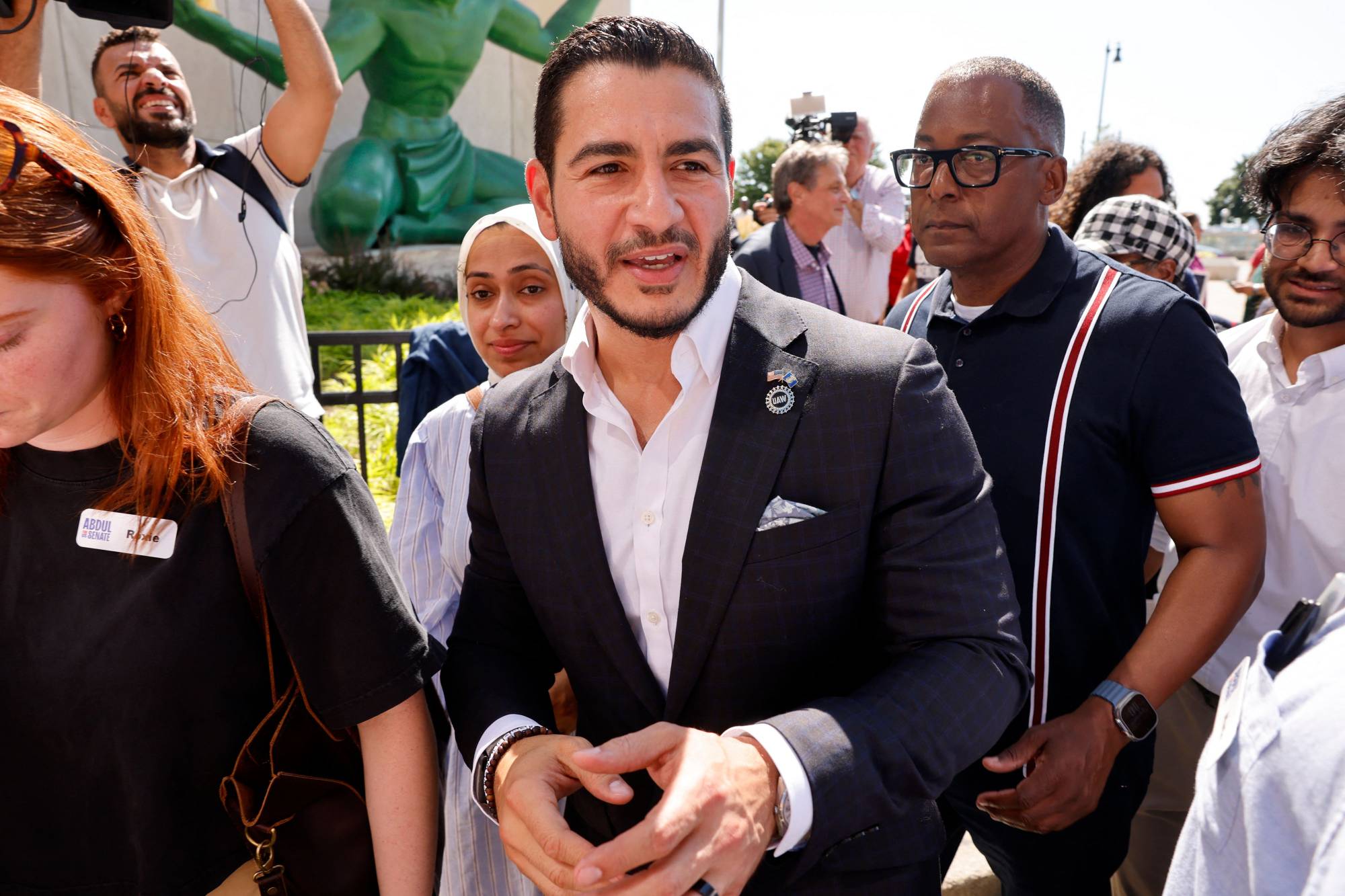
US Democratic Senate candidate from Michigan Abdul El-Sayed departs after a press conference declaring victory in the primary election in Detroit, Michigan, on August 5, 2026. (Photo by JEFF KOWALSKY / AFP)

He was the University of Michigan's first Rhodes Scholar since 2004. At Oxford, he continued playing lacrosse and earned a Full Blue, the university's highest sporting honor, as team captain.

By 2014, El-Sayed had completed his medical education, earning his medical degree from Columbia University's College of Physicians and Surgeons.

He subsequently joined Columbia's faculty as an assistant professor of epidemiology. Months later, then-Detroit Mayor Mike Duggan appointed him health officer and executive director of the city's Health Department.

El-Sayed rebuilt Detroit's Health Department following the city's bankruptcy. He later restructured Wayne County's Department of Health, Human and Veterans Services, which serves 1.8 million residents in Michigan's largest and most diverse county.

As a public servant, El-Sayed secured free eyeglasses for children in need, challenged some of Michigan's biggest polluters and expanded access to the lifesaving overdose-reversal medication naloxone, commonly known by the brand name Narcan.

He also spearheaded a program to eliminate up to $700 million in medical debt for 300,000 Michigan residents over two years.

His work earned him recognition as Public Official of the Year from the Michigan League of Conservation Voters and a place on Crain's Detroit Business's 40 Under 40 list.

Nationally recognized for his expertise in improving the American healthcare system, El-Sayed is the author of Medicare for All: A Citizen's Guide.

He later returned to public service as director of Wayne County's Department of Health, Human and Veterans Services, serving from December 2022 until April 2025, when he resigned to seek elected office once again, this time in the US Senate.

El-Sayed has also made a name for himself as a podcast host, including through America Dissected.

His medical credentials have attracted controversy, largely because he has described himself as a physician despite not holding a license to practice medicine in Michigan.

Although he studied medicine, El-Sayed came to believe that a broken political system was what was making people sick. That conviction ultimately led him to run for the Senate.

According to his campaign website, he entered the race because he believes life in America should not be so difficult and wants to build a government that serves ordinary Americans rather than Elon Musk, Donald Trump and their billionaire allies.

Responding to questions about his medical credentials in July, El-Sayed said: "I did graduate from a school that's literally called Columbia College of Physicians and Surgeons. So, you know, you can go have that argument with Columbia University if you'd like."

In his only previous bid for elected office, El-Sayed finished second to Gretchen Whitmer in Michigan's 2018 Democratic gubernatorial primary, ahead of Shri Thanedar, who subsequently won a seat in the state legislature and later in the US House of Representatives.

Throughout his Senate campaign, El-Sayed distilled his platform into a three-part message: "Money out of politics, money in your pocket, Medicare for All."

He repeatedly emphasized that he was the only candidate running for the US Senate in Michigan who had never accepted a dime of corporate campaign money and never would.

El-Sayed lives in Ann Arbor with his wife, Sarah, and their two young daughters, Emmalee and Serene.


Numbers That Tell the Story of the Democrats’ Midterm Blowout

This aerial view shows Union Station illuminated with the colors of the US flag after the midterm elections in Kansas City, Missouri, in the early hours of November 4, 2026. (AFP)
TT

Numbers That Tell the Story of the Democrats’ Midterm Blowout

This aerial view shows Union Station illuminated with the colors of the US flag after the midterm elections in Kansas City, Missouri, in the early hours of November 4, 2026. (AFP)

Democrats stormed back to power in Congress and governors' mansions across America in Tuesday's midterm elections, a stunning repudiation of Donald Trump's political agenda.

These are the numbers that tell the tale of a historic night.

- Record turnout -

Total turnout numbers were not in yet, but Americans cast more than 61.7 million votes even before election day, according to the University of Florida's Election Lab.

That figure, a runaway record for early voting in US midterms, undoubtedly boosted Democrats, who traditionally cast their ballots early more often than Republican voters.

The numbers showed large turnout among African Americans, young people and other groups that typically support Democratic candidates, National Public Radio reported.

The surge contributed to a wave election, with Democrats running the table on key races and seizing control of both chambers of Congress.

- Record fundraising -

Total spending for the 2026 midterms soared to a record $11.9 billion, substantially higher than the $8.9 billion racked up in 2022, according to OpenSecrets, a non-partisan authority on spending in US politics.

Campaign fundraising and ad buys jumped in the 2026 races, driven by the outside spending of so-called political action committees.

Such outside spending, led by Trump's mega-billionaire ally Elon Musk, favored Republicans by some $360 million.

But Democratic candidates proved adept at raising their own funds.

House and Senate candidates spent an unprecedented $3.7 billion from their campaign warchests, with Democrats outspending Republicans by $800 million, according to OpenSecrets.

In Texas, Democratic Senate candidate James Talarico broke records by bringing in a staggering $145 million, several times the $22 million raised by his Republican rival Ken Paxton who was forced to rely on outside groups to fund his campaign.

- First wins in decades -

Ninety-four years ago was the last time Kansas sent a Democrat to the US Senate. But on Tuesday night, Adam Hamilton unseated Republican incumbent Roger Marshall.

Hamilton, the pastor of a Methodist megachurch who was registered as a Republican until recently, became the first Democrat to win a Senate race in the largely rural, conservative state since 1932.

Texas also went blue for the first time in decades, with Talarico scoring a massive upset to flip a Senate seat in the Lone Star State for the first since 1988 -- the year before Talarico was born.

South Carolina also defied history, ousting Senator Darline Graham -- who had been appointed earlier this year to fill the seat of her late brother Lindsey Graham -- in favor of Democrat Annie Andrews. No South Carolina Democrat had been elected to the Senate since 1998.

- Young voters, Latinos turn away -

Young men and Latino voters -- two segments of the American electorate crucial to Trump -- turned sharply away from the president and his Republican Party, exit polls showed.

Hispanic voters had helped bring Trump to power in 2016, and were instrumental in his victory in 2024, when they only narrowly went to Democrat Kamala Harris in the presidential election, 51 percent to 48 percent, according to Pew Research.

But in recent weeks, several Latino voters have expressed anger at Trump, saying they felt betrayed.

It showed in NBC News exit polls on Tuesday, when Latino voters backed Democratic candidates by 62 percent to 35 percent over Republicans.

Young voters also soured on Trump. NBC News reported that its exit polls showed 18-29-year olds, men and women, voted for Democrats by a 72 percent to 25 percent margin. That is a sharp shift from 2024 when young voters were split between Trump and Harris.